Malaysia Advances Open Finance: Strengthening Trust, Inclusion, and Innovation in Financial Services
Advancing Open Finance as a Strategic Enabler for Secure, Inclusive, and Innovation-Driven Financial Services


Open Finance marks a paradigm shift in how Malaysians can control and interact with their financial data. By enabling secure, customer-permissioned data sharing, it empowers individuals and businesses to access more tailored and efficient financial solutions. At this year’s MyFintech Week (MyFW) 2025, the fireside panel “Open Finance Unleashed: Opportunities and Challenges” explored how this new model can unlock new possibilities for consumers, firms, and the broader financial ecosystem.
Held in Kuala Lumpur from 4 to 7 August 2025, and co-organised by Bank Negara Malaysia (BNM), Securities Commission Malaysia (SC), Malaysia Digital Economy Corporation (MDEC), the Asian Institute of Chartered Bankers (AICB), and the Fintech Association of Malaysia (FAOM), MyFW 2025 gathered regulators, financial institutions, fintech innovators, and industry players from across ASEAN to explore the future of finance. Over four packed days of interactive panels, workshops, masterclasses, and showcases, attendees delved into key issues shaping the industry, from financial innovation and sustainable finance, to operational resilience.
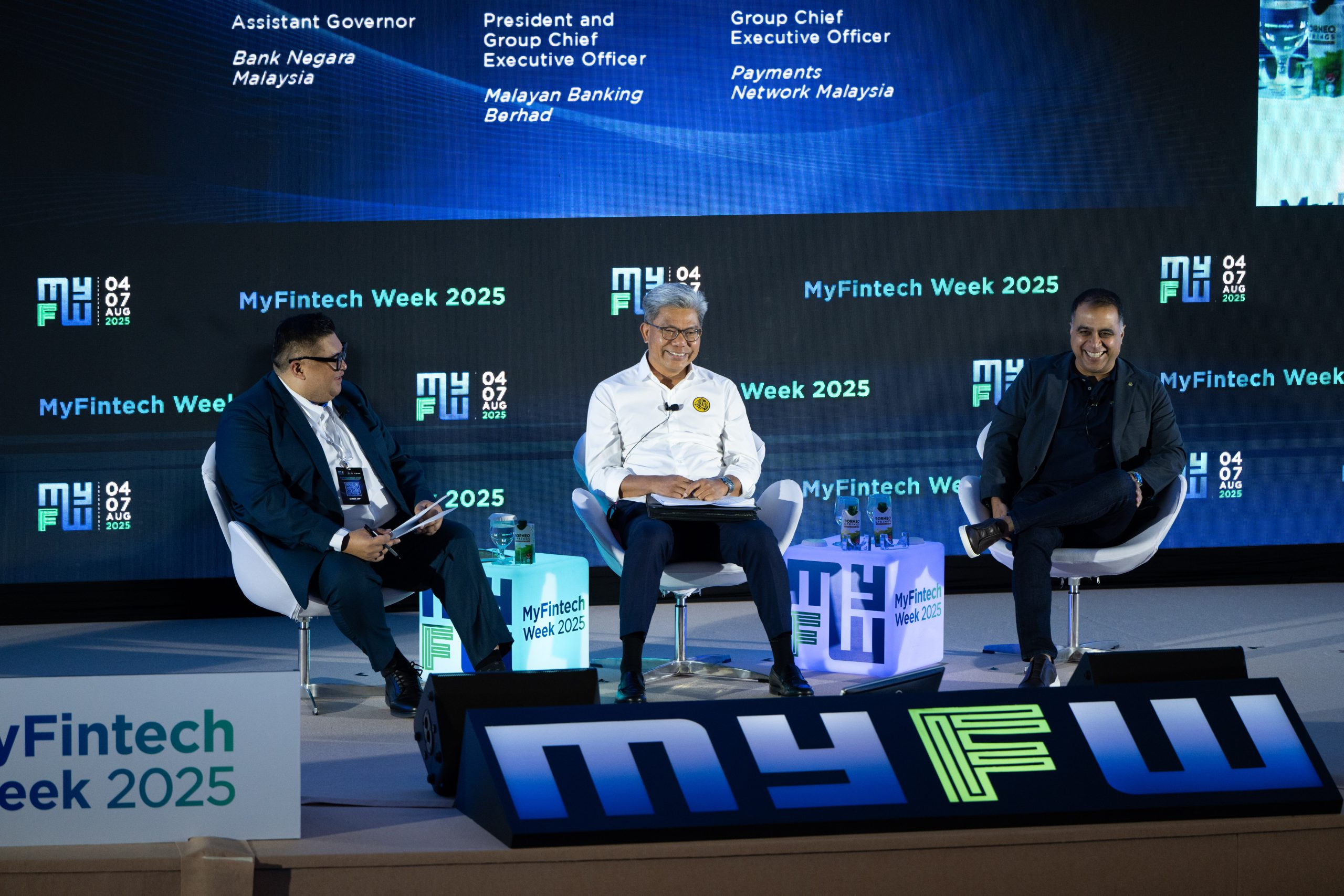
Moderated by Assistant Governor Suhaimi Ali of Bank Negara Malaysia, the fireside chat featured Farhan Ahmad, Group CEO of Payments Network Malaysia (PayNet), and Dato’ Sri Khairussaleh Ramli, President and Group CEO, Malayan Banking Berhad. The session explored how Open Finance can be implemented in a way that is secure, inclusive, and responsive to evolving consumer needs.
What Is Open Finance, Really?
At its core, Open Finance is about empowering consumers to control how their financial data is shared and used, including what data to share, with whom, for what purpose, and for how long. The platform, currently being developed by PayNet, will enable encrypted, consent-based data flows across financial institutions and third-party providers—without the platform itself storing or viewing customer data.
This infrastructure opens the door to more relevant, real-time, and personalised services. As Farhan summarised, “You have one dashboard where you can see everything about your finances. You can make better decisions based on that, which could be the difference between financial success or failure.”
“What’s key for us as a bank is to make sure that we continue to focus on the customer journey. We are all customers of various banks. What if it’s just one dashboard?” said Dato’ Sri Khairussaleh Ramli, underscoring the potential of Open Finance to deliver more user-centric financial services.
Why It Matters—Especially Now
As financial activity becomes increasingly digital, Open Finance offers a safer and more efficient alternative to current data-sharing practices. Instead of emailing PDFs or relying on couriers to deliver physical copies of bank documents, consumers will be able to instruct their bank to transmit data directly to another institution, thereby reducing friction, enhancing security, and improving user experience.
“Open Finance really unlocks an enormous amount of value going forward and mitigates the risk of data sharing,” added Farhan. The aim is simple: to make consent-based sharing the norm. That means traceability, transparency, and less friction for consumers navigating the financial landscape. It also supports broader efforts to modernise financial infrastructure and reduce reliance on manual processes.
Opening Access, Driving Inclusion
Beyond convenience, Open Finance is a strategic lever for financial inclusion. By enabling access to alternative data such as transaction history, financial institutions can better serve underserved segments, including gig workers and micro-entrepreneurs. As noted during the panel, this could support Bank Negara Malaysia’s broader objectives of narrowing protection gaps and expanding access to quality financial services.
“One of the key beneficiaries of Open Finance is the underserved segment. Data about them gets richer. Perhaps a bank can build a better model in terms of providing credit or financing for this segment,” said Dato’ Sri Khairussaleh, on how Open Finance can expand financial inclusion for communities previously overlooked by traditional banking systems.
Where Malaysia Stands
Bank Negara Malaysia is guiding the national journey toward Open Finance through a phased, whole-of-system approach. “Bank Negara will provide regulatory clarity in terms of the scope and how the industry will then navigate the journey going forward,” said Suhaimi Ali, outlining the central bank’s role in guiding the industry through Malaysia’s Open Finance roadmap. An Exposure Draft will be issued in 2H 2025 to provide regulatory clarity on participation criteria, mandated datasets, and expectations for consent management and customer protection.
Technical development is underway through PayNet, the national payments network, with support from a pilot group comprising seven banks and the Employees Provident Fund (EPF). “We’re enabling a system, powering the middle layer which is the transportation of information safely and securely from point A to point B,” said Farhan. The platform is being designed as a secure intermediary layer for transmitting financial data between institutions, without storing or viewing customer information. According to the panellists, implementation could begin as early as mid-2026. The MyFW panel also indicated that with groundwork actively underway, industry players are encouraged to get ready now.
Open Finance: From Vision to Reality
The success of Open Finance depends on one thing: trust. All data sharing under Open Finance will be subject to applicable laws and standards, including the Personal Data Protection Act (PDPA), Financial Services Act (FSA), Islamic Financial Services Act (IFSA), and Development Financial Institutions Act (DFIA), and will be aligned with global privacy norms and best practices.
Safeguards are being embedded into the platform’s design, including encrypted data flows, secure authentication, and consent frameworks, as well as clear redress mechanisms to ensure that data sharing is conducted responsibly and transparently. The panel highlighted the centrality of consent in Open Finance, noting that it enables consumers to exercise comprehensive oversight and transparency concerning the use of their data. Consumers will have complete authority, and clear visibility over how their information is utilised, with access strictly confined to customer-permissioned activities such as underwriting or account verification. “The premise of Open Finance is that when I give consent, I’m not giving it to my broker or to anybody except the risk officer at the bank to underwrite my loan. I can trust them to be responsible with my data. Consent is a very integral part of Open Finance. And in this case, you will have full right and visibility,” said Farhan.
Malaysia’s push for Open Finance reflects its commitment to progressive, inclusive, and secure digitalisation of financial services. With strong industry alignment, and a clear regulatory roadmap, Malaysia is well-positioned to lead the region in building a trusted data-sharing ecosystem.