Philippines’ SEC Breach: Your TIN Could Be Out There—and the Explanation Is Doing a Lot of Work
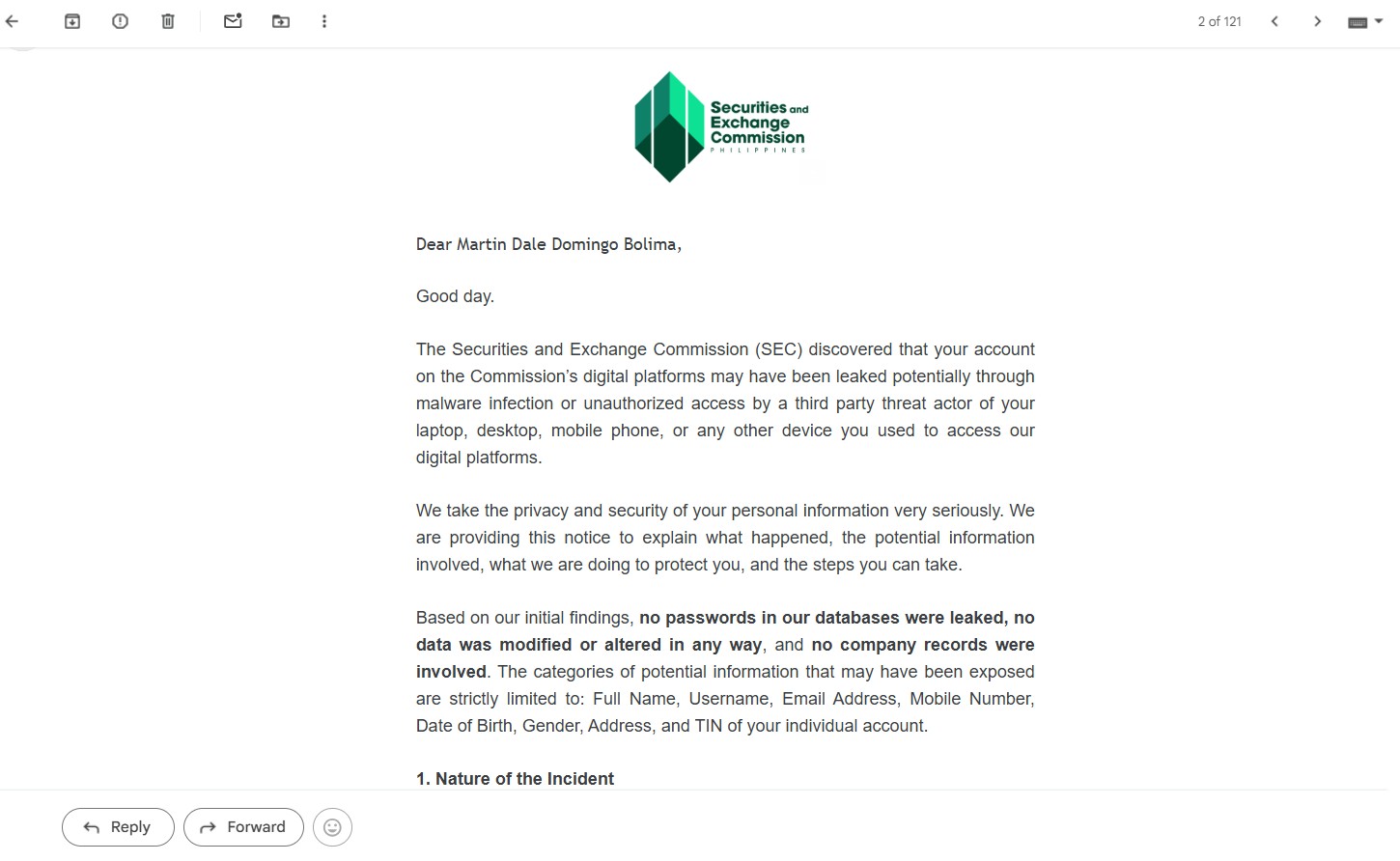
Potentially Exposed Information Include Full Names, Usernames, Email Addresses, Mobile Numbers, Dates of Birth, Genders, Physical Addresses, and Tax Identification Numbers


When a regulator tells you your data may have leaked, it helps to ask who regulates the regulator. The Philippines’ Securities and Exchange Commission (SEC) is the body that polices corporate disclosure and governance in the country. This week it is the one making the disclosure.
What Happened
The sequence matters, so here it is. On 5 November, the cybersecurity advocacy group Deep Web Konek flagged a forum listing offering 487,000 lines of alleged SEC data for sale. The SEC says it detected the incident on 6 November. A day later it issued an advisory acknowledging online reports of an alleged leak. On 9 November, it confirmed the breach, sent notices to affected account holders and formally reported the incident to the National Privacy Commission.
What Was Exposed
The SEC says the potentially exposed information is limited to individual profile data: full names, usernames, email addresses, mobile numbers, dates of birth, genders, physical addresses, and Tax Identification Numbers.
The SEC says passwords stored in its databases were not leaked, corporate filings were unaffected, and system data was neither altered nor destroyed.
That is reassuring, and it is true as far as it goes. But “no passwords” is not the same as “no harm.” The data on that list is the kind that fuels the most targeted scams in the country. Name, number, birthday, address and tax ID in one place is a ready-made script for a convincing fraudster. Imagine a call from someone who knows your full name, your TIN and your date of birth, and says they are from a government office. Many people would not question it.
The SEC Explanation That Raises Questions
The SEC has suggested the leak may have originated from malware infections or unauthorised third-party access targeting individual devices used to log into its portals. In other words, users’ own devices, not the SEC’s servers.
That may turn out to be true. But the SEC’s actions tell a more complicated story. It says it has reinforced access controls, updated authentication credentials and implemented additional monitoring rules across its digital infrastructure, and launched a system-wide audit of all its digital platforms. You do not usually overhaul your own access controls and audit every platform because someone else’s laptop caught a virus.
The agency is also careful about what it has not said. It has not confirmed whether the 487,000-line dataset circulating online is connected to the incident it detected. It has yet to release the total number of affected users. For now, the origin, scope and validity of the dataset are still being verified.
Fair enough: investigations take time, and rushing out a firm answer would be worse. But readers should note the gap between a confident “not our servers” theory and an unfinished investigation.
A Pattern, Not an Isolated Case
The SEC is not alone this week. BIR is separately investigating an online claim involving 340,000 records, and neither claim has been independently verified. Two tax-and-corporate-identity data sets surfacing within days is, at the very least, an uncomfortable coincidence. It also follows a long line of Philippine government data incidents, including the 2016 COMELEC breach, after which the National Privacy Commission found the agency responsible for violating the Data Privacy Act.
The legal clock is worth watching. NPC rules require breach notification within 72 hours of knowing, or reasonably believing, that a notifiable breach has occurred. The SEC says it detected the incident on 6 November and notified the NPC on 9 November, which sits roughly on that line. Whether the NPC considers it compliant will be a fair question to ask.
Who Should Be Concerned
Anyone with an account on an SEC online platform, including individuals who file or register businesses, corporate officers, and accountants or lawyers acting for clients. The SEC says it is notifying affected users directly, but with the user count unknown, assume nothing and check your inbox.
What to Do
- Change your password on your SEC account and on any other account that reuses it. The SEC itself advises this.
- Turn on multi-factor authentication wherever it is offered.
- Scan your devices for malware. Given the SEC’s own theory, this is worth doing properly, not as a formality.
- Treat unexpected calls, texts and emails with suspicion, especially those that quote your personal details. The SEC says it will never ask for your passwords or security PINs.
- Use official portals only, and never click verification links sent to you unprompted.
- Direct questions to the SEC’s Data Protection Officer, Oliver V. Chato, whom the commission has named as the contact.
The Bottom Line
The commission has done several things right: it disclosed, it notified the NPC, it told users what to do. It has also done what many organisations do under pressure, which is lean on a reassuring cause before the investigation has finished.
For the people whose TINs are now in someone else’s hands, the cause matters less than the consequence. A password can be changed. A tax ID and a date of birth cannot. The people holding them are in no hurry.
(Reporting as of 10 November 2026. The investigation is ongoing and figures may change.)