Semperis Study Finds AI Expanding Singapore Organisations’ Identity Attack Surface
Most Singaporeans Prioritising AI Identity Governance as AI Agents Gain Access to Sensitive Systems and Security Workflows

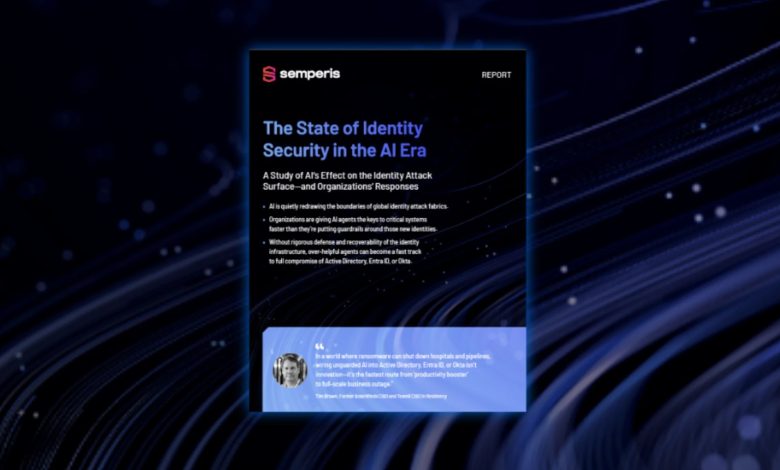
Semperis, the identity-driven cyber resilience and crisis response company, has published findings from a global study examining how Artificial Intelligence (AI) is reshaping the attack surface of enterprise identity systems, including Active Directory, Entra ID, and Okta. The semperis study shows that AI is quietly redrawing the boundaries of global identity attack surfaces and organisations are giving AI agents the keys to critical systems faster than they are putting guardrails around those new identities.
The State of Identity Security in the AI Era study, surveyed 1,100 organisations across the US, UK, France, Germany, Italy, Spain, Australia and Singapore. It found that 66% of organisations in Singapore believe AI will increase attacks on identity infrastructure. At the same time, as high as 93% of the organisations either already use or plan to use AI agents for sensitive security tasks such as password resets and VPN access.
“Singapore organisations have been quick to explore AI across business and security operations, but every AI agent introduced into the enterprise also creates a new identity that must be governed, monitored and recovered if compromised,” said Gerry Sillars, Semperis Vice President of Asia Pacific and Japan. “It’s encouraging that 90% of Singapore respondents see AI identity governance as a priority, but priority must translate into practical controls. As AI moves closer to privileged systems, identity resilience needs to be built into AI adoption from the start,” said Gerry Sillars, Semperis Vice President of Asia Pacific and Japan.
Singapore’s Situation Mirrors That of the World Says Semperis
Singapore trends reflect a broader global concern: as organisations deploy AI agents across more sensitive workflows, they are dramatically increasing the number of non-human identities connected to critical systems.
“The accelerated use of AI is introducing a bevy of new agents, each with its own non-human identity (NHI) throughout global enterprises and many companies are just way too optimistic about their ability to recover their identity infrastructure following a breach, even as they expand this landscape of NHIs,” said Alex Weinert, Semperis Chief Product Officer.
Globally, only 65% of organisations say AI identities are fully registered, authenticated, and authorised in a formal system, while 6% admit they do not track them at all. In organisations that do track AI identities, 57% use the same system as for human identities, while 43% authenticate and authorise them using a separate system.
This adds a new layer of complexity for security teams in Singapore. AI agents may not behave like human users, but they can still hold access, interact with sensitive systems and become part of the organisation’s identity fabric. Without clear registration, authentication, authorisation and recovery processes, these non-human identities can widen the attack surface and complicate incident response.
Are Organisations Ready for AI-Fuelled Identity Breaches?
The Semperis study found that AI is already being placed close to sensitive identity infrastructure. More than a quarter of surveyed organisations (29%) already use AI agents to manage security‑related help desk tickets, including password resets and VPN access. Another 65% intend to do so within the next year.In parallel, 92% of respondents say that some percentage of their workforce has AI installed on local machines where it can access SSH and encryption keys.
For Singapore organisations, where AI adoption is increasingly being explored across business operations, security and productivity use cases, this reinforces the need to treat AI agents as part of the enterprise identity environment rather than as standalone tools.
“The pattern of global organisations overestimating how quickly they can recover from a cyberattack is real, especially when identity is within the blast radius. On paper, organisations have plans and backups; in practice, identity failures turn technical incidents into prolonged business crises, exposing a dangerous gap between perceived resilience and reality,” said Chris Inglis, the first U.S. National Cyber Director and Semperis Strategic Advisor.
On the plus side, 90% of respondents in Singapore indicated that AI identity governance is a priority for them in the coming months. So, how can organisations govern these hard-to-control identities? For now, best practices include:
- Treat AI agents explicitly as non-human identities in the identity fabric.
- Enforce least‑privilege, just‑enough and just‑in‑time access for agents as rigorously as for humans.
- Segregate agent and human trust boundaries where appropriate.
- Use UEBA‑style analytics to detect “zombie” or anomalous agent behaviour.
- Ensure that your organisation can quickly recover identity systems to a trustworthy state if they are breached.
The full Semperis AI Study can be obtained here: The State of Identity Security in the AI Era.